Back to 2025 Abstracts
Vitamin D receptor is necessary for metabolic health after sleeve gastrectomy
Weronika Stupalkowska
1, Lei Zhao
2, Cullen Roberts
1, Yingjia Chen
1, Gavin Bewick
3, Francesco Rubino
3, Sloan Devlin
*4, Eric Sheu
1, Andrei Moscalu
11Laboratory for Surgical and Metabolic Research, Brigham and Women's Hospital, Boston, MA; 2Department of Pathology, Brigham and Women's Hospital, Boston, MA; 3School of Cardiovascular & Metabolic Sciences, King's College London, London, United Kingdom; 4Department of Biological Chemistry and Molecular Pharmacology, Harvard Medical School, Boston, MA
Background Vitamin D deficiency associates with obesity and type 2 diabetes (T2D). Vitamin D receptor (VDR) is expressed almost ubiquitously in the human body, regulating insulin sensitivity and immune system amongst other functions. Bariatric surgery remains the most effective treatment for obesity and T2D and whether this depends on intact VDR signaling is unknown. Here, we assessed the role of VDR in the metabolic response to sleeve gastrectomy (SG).
Methods Whole body VDR knockout (KO) and wild type (WT) C57BL/6J mice were fed calcium-phosphate-lactose supplemented high-fat (60%) diet from weaning until the end of the study. 12-week-old, weight-matched male mice were randomly assigned to either SG or sham procedure. Animals underwent oral glucose (OGTT) and insulin tolerance tests (ITT), and indirect calorimetry. White adipose tissue (WAT) and liver were collected for histological analysis upon animal sacrifice at 15 weeks postoperatively.
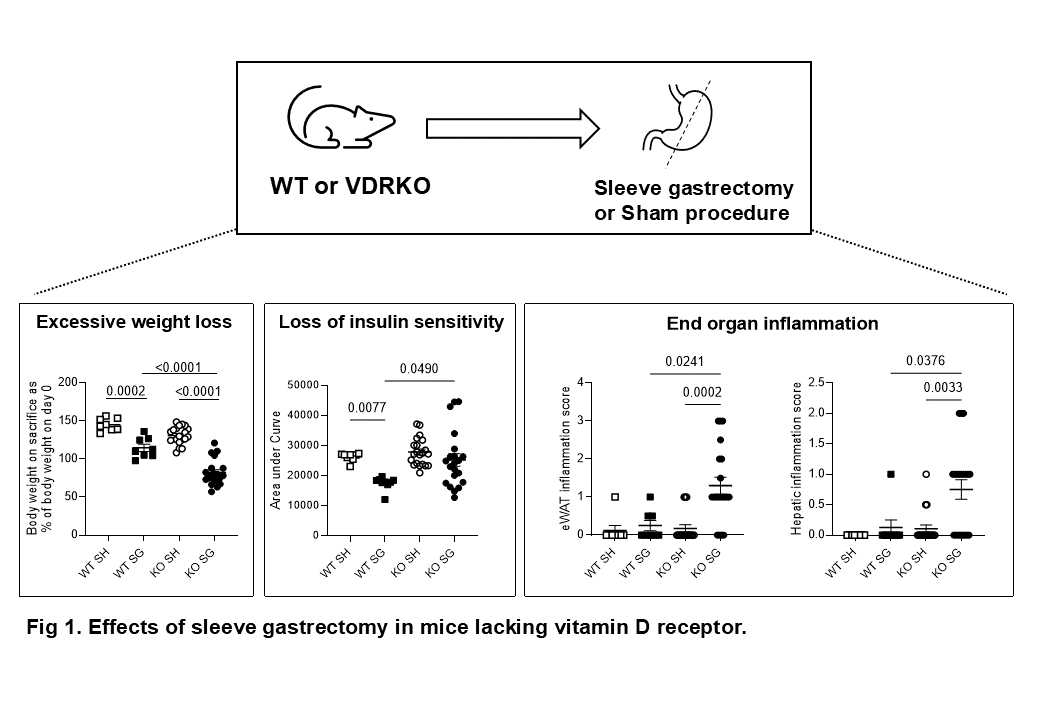
Results SG reduced body weight (BW) regardless of genotype, however, with time, KOSG mice started to exhibit excessive weight loss (mean (±SD) BW on sacrifice as % of BW on day 0: WTSH= 145.3% (±8.2), WTSG= 114.8% (±13.2), KOSH= 131.1% (±11.6), KOSG= 82.2% (±16.9); p<0.0001). This was associated with significantly lower WAT mass in KOSG mice (median (IQR) epididymal WAT mass as % of BW: WTSH= 6.2% (1.3), WTSG= 5.5% (1.0), KOSH= 5.9% (3.5), KOSG= 2.1% (3.5), p=0.0004). Moreover, SG in KO mice resulted in reduced size and necrosis of adipocytes, with increased inflammation in both epididymal (p<0.0001) and inguinal (p=0.0105) WAT, and the liver (p=0.0007). SG did not have a significant effect on energy expenditure (EE) in WT mice (p=0.752) but in KOSG mice there was an interaction effect between surgery and BW (p=0.042), with steep increase in EE per unit increase in BW. Glucose tolerance was improved after SG regardless of genotype, as evidenced by the reduction in OGTT Area under Curve (AUC) in WT group (-36.9%, p=0.0014 at 2 weeks postoperatively and -39.7%, p<0.0001 at 8 weeks) and KO group (-36.1%, p<0.0001 at 2 weeks and -33.7%, p<0.0001 at 8 weeks). However, the initial SG-induced improvement in insulin sensitivity (reduction in 5-week ITT AUC: WT -29.3%, p=0.0339, KO -25.2%, p=0.0025) was lost over time among KO mice (reduction in 9-week ITT AUC: WT -33.2%, p=0.0077; KO -9.5%, not significant).
Conclusion VDR is necessary for metabolic health after SG due to its role in regulation of energy expenditure, insulin sensitivity, adipose tissue and immune function.