Back to 2025 Abstracts
Examining One-Year Readmission Rates for Recurrent Pancreatitis Following an Initial Acute Pancreatitis Episode
Ikemsinachi C. Nzenwa
*, Jack Miller, Yasmin Arda, Vahe S. Panossian, Yasmin G. Hernandez-Barco, Michael P. DeWane, Katherine Albutt, Carlos Fernandez-del Castillo, Keith Lillemoe, Andrew Warshaw, Peter Fagenholz, Casey M. Luckhurst
Massachusetts General Hospital, Boston, MA
Background: Acute pancreatitis (AP) is among the most common gastrointestinal conditions requiring hospitalization. An initial AP episode can lead to a more challenging clinical course, with approximately 20% of patients developing recurrent AP, of whom 35% progress to chronic pancreatitis. However, the risk of recurrent pancreatitis within one year following an initial AP episode remains unclear. Using a national dataset, we analyzed one-year readmission rates for recurrent pancreatitis, with a focus on stratifying recurrence based on the underlying etiology of the initial AP episode.
Methods: We conducted a retrospective analysis of the 2016–2019 Nationwide Readmissions Database. Adult patients (?18 years) admitted in January of each year with acute pancreatitis and discharged alive were included. Exclusion criteria included elective admissions and diagnoses of pancreatic cancer or unspecified pancreatitis. We recorded all recurrent pancreatitis readmissions within 11 months of the index hospitalization. Patients were stratified into four etiologic cohorts using ICD-10 diagnosis codes: alcohol, biliary, drug-induced, and idiopathic AP.
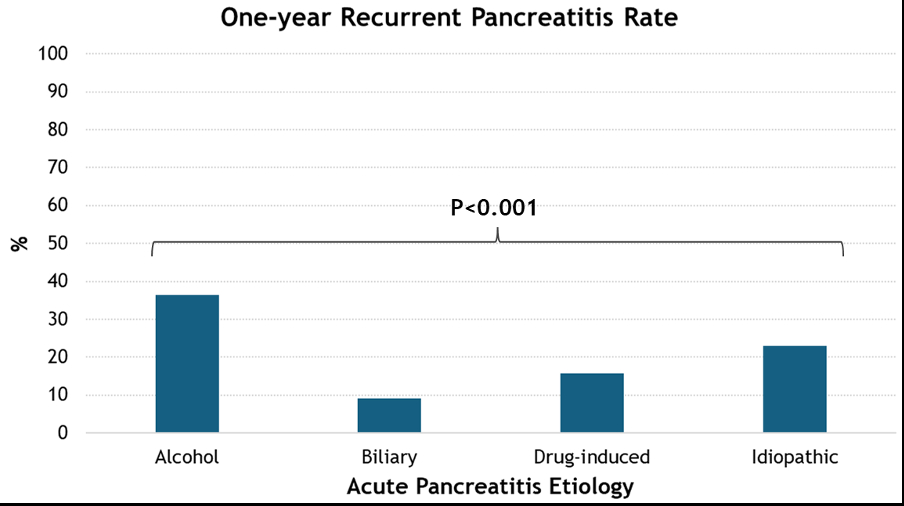
Results: A total of 31,825 patients initially presented with AP. The median age was 52 (38-64) years and 54% were male. The median Elixhauser comorbidity index was 5 (1-11). On admission, 2.8% and 0.7% of patients had necrotizing and infected AP respectively. The most common AP etiologies were alcohol (46.4%), biliary (43.6%), idiopathic (6.7%), and drug-induced (3.3%). Procedural pancreatic intervention was performed in 1%. Overall, the one-year recurrence rate was 23%. The one-year recurrence rate for alcohol, biliary, drug-induced, and idiopathic AP was 36.5%, 9.1%, 15.8%, and 22.9%, respectively (Figure 1). Most patients (56%) experienced only one recurrent pancreatitis episode and patients with AP secondary to alcohol were most likely to experience ? 5 recurrent pancreatitis episodes.
Conclusion: Our study provides critical insights into one-year recurrence patterns of AP, revealing substantial variation by etiology. The overall recurrence rate of 23% underscores the need for targeted interventions, particularly for high-risk groups such as patients with alcohol-induced AP, who had the highest recurrence and multiple readmissions. Early risk stratification and proactive management of modifiable risk factors could help prevent recurrent AP and progression to chronic pancreatitis.